

 Hospital Furniture
 Medical Devices
 MSR Products
 Office Furniture
Hospital beds are the cornerstone of patient care, safety, and recovery. They combine comfort, durability, and advanced features to support diverse clinical needs. This catalog presents the 10 major categories of hospital beds, with history, specifications, annotated diagrams, applications, compliance, maintenance, pricing tiers, and customization options.
General Ward Bed
History: General ward beds are the earliest form of hospital beds, designed for shared wards. Initially made from iron frames with simple designs, they evolved to include adjustable sections and durable materials.
Short Specifications:
– Fixed height
– Mild steel or stainless-steel frame
– Detachable head & foot boards
– Side rails (optional)
– Mattress platform with ventilation holes
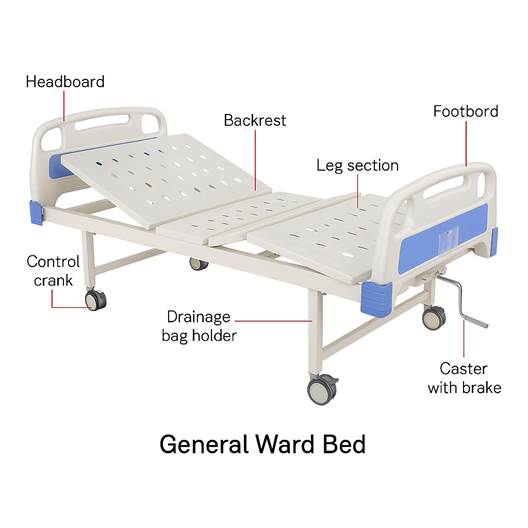
General Ward Bed – Annotated Diagram
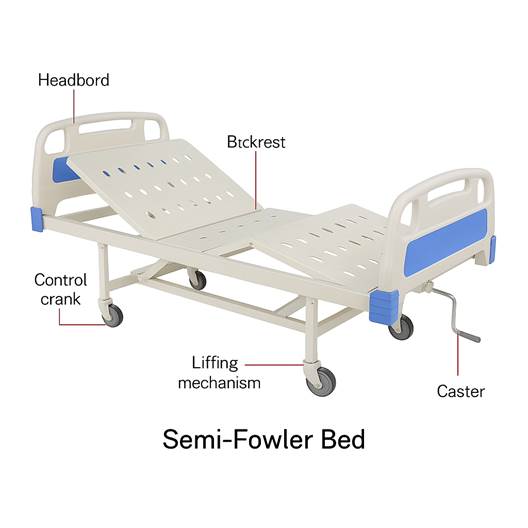
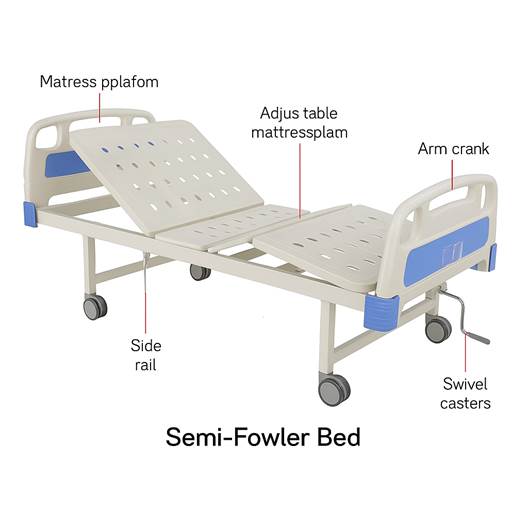
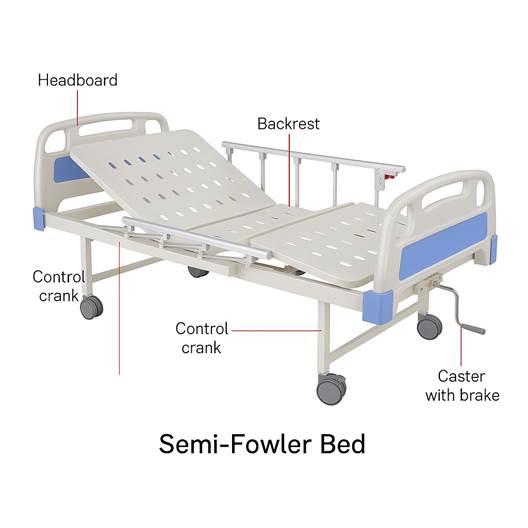
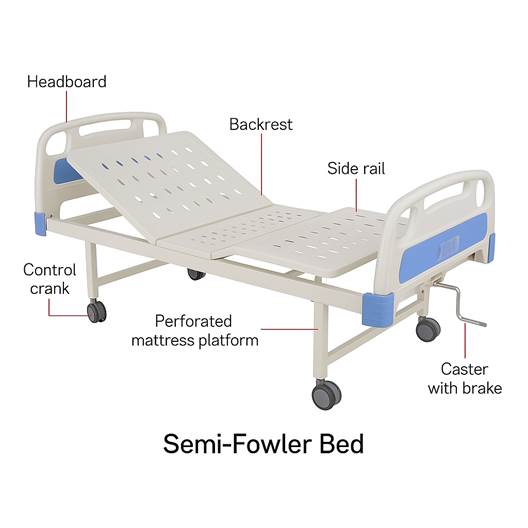
Semi-Fowler Bed
History: Semi-Fowler beds were introduced to improve patient comfort, especially for those who needed partial backrest elevation. Widely adopted in the mid-20th century.
Short Specifications:
– Adjustable backrest via crank or motor
– Steel or ABS head/foot panels
– Collapsible side rails
– Provision for IV pole and urine bag holder
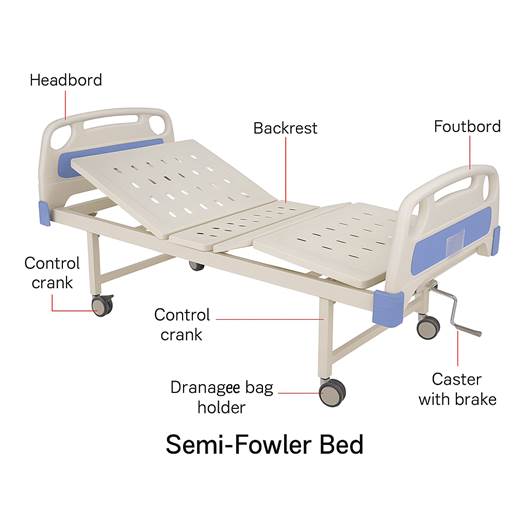
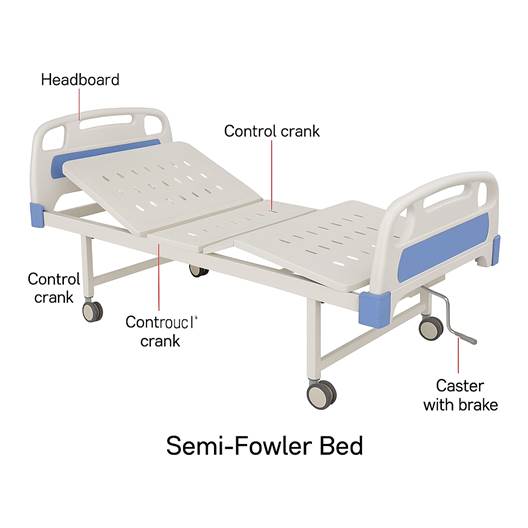
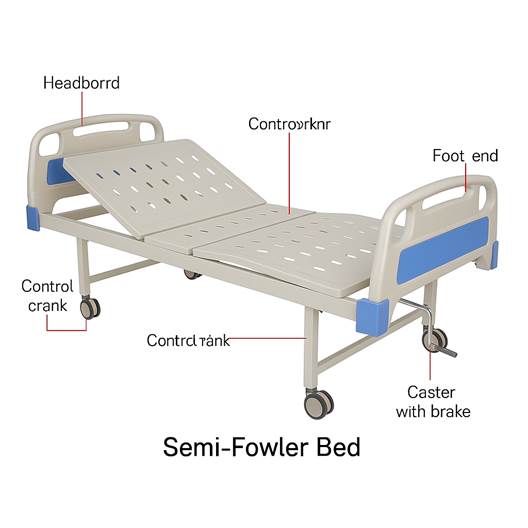
Semi-Fowler Bed – Annotated Diagram
Full Fowler Bed
History: Full Fowler beds evolved from Semi-Fowler beds to offer both backrest and knee rest adjustments. They became a standard in many hospitals worldwide.
Short Specifications:
– Adjustable backrest & knee rest
– Four-section platform
– Manual crank or electric adjustment
– Heavy-duty wheels with brakes
– Side rails for patient safety
ICU/CCU Bed
History: ICU/CCU beds developed alongside intensive care medicine in the late 20th century. They are designed for maximum adjustability and integration with monitoring devices.
Short Specifications:
– 5–7 function motorized adjustments
– Trendelenburg & reverse Trendelenburg positions
– Central braking system
– Integrated weighing system (optional)
– CPR release function
ICU/CCU Bed – Annotated Diagram
Emergency & Trauma Bed
History: Emergency beds emerged to support rapid response situations, offering quick mobility and adjustability. These are also known as stretchers or trauma trolleys.
Short Specifications:
– Height adjustable (manual/hydraulic)
– X-ray permeable platform
– Folding side rails
– Oxygen cylinder holder
– Swivel casters with brakes
Emergency & Trauma Bed – Annotated Diagram
Pediatric Bed
History: Pediatric beds were developed with child safety in mind. They include high side rails and cheerful designs to reduce anxiety for young patients.
Short Specifications:
– Smaller dimensions
– High collapsible side rails
– Anti-bacterial coating
– Provision for IV pole
– Rounded edges for safety
Pediatric Bed – Annotated Diagram
Maternity/Delivery Bed
History: Maternity and delivery beds evolved from obstetric tables to multi-position beds that support labor, delivery, and recovery in the same unit.
Short Specifications:
– Adjustable backrest and leg supports
– Detachable foot section
– Lithotomy position support
– Stainless steel bowl for fluids
– Motorized or manual operation
Maternity/Delivery Bed – Annotated Diagram
Bariatric Bed
History: Bariatric beds were introduced to support obese patients, with reinforced structures and wider platforms. They became common in the late 20th century.
Short Specifications:
– Extra-wide frame (up to 54 inches)
– High weight capacity (300–500 kg)
– Motorized adjustments
– Reinforced side rails
– Heavy-duty casters
Bariatric Bed – Annotated Diagram
Electric Hospital Bed
History: Electric beds became standard in advanced hospitals in the late 20th century. They offer remote-controlled adjustments for patient comfort and clinical efficiency.
Short Specifications:
– Multi-function motorized adjustments
– Handset remote control
– ABS head/foot boards
– Emergency power backup (optional)
– Central locking system
Electric Hospital Bed – Annotated Diagram
Manual Hospital Bed
History: Manual beds continue to be widely used in developing countries due to affordability. They operate with cranks for adjustments instead of motors.
Short Specifications:
– Adjustable backrest and/or knee rest (manual cranks)
– Detachable head & foot boards
– Steel frame with epoxy coating
– Swivel casters with brakes
– Side rails (optional)
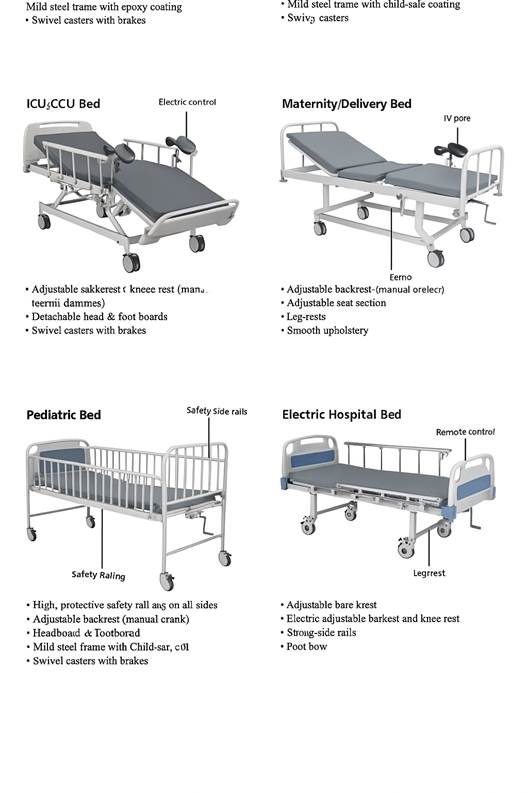
Manual Hospital Bed – Annotated Diagram
Applications & End Users
Hospital beds are used across all healthcare facilities. Applications include:
– General ward beds: Standard patient accommodation
– Semi-Fowler & Full Fowler beds: Improved comfort for medical wards
– ICU/CCU beds: Critical care units
– Emergency & trauma beds: Emergency departments
– Pediatric beds: Children’s hospitals and pediatric wards
– Maternity/delivery beds: Obstetric and gynecological units
– Bariatric beds: Specialized care for obese patients
– Electric beds: Modern multi-specialty hospitals
– Manual beds: Cost-effective solution for clinics and smaller hospitals
Compliance & Standards
Hospital beds are manufactured under strict safety and quality standards:
– ISO 13485 certification for medical devices
– CE Marking for European market compliance
– FDA clearance for the US market
– DGDA/BSTI certification for Bangladesh
– Fire-retardant and antimicrobial mattress options
– Patient safety regulations, including side rails and emergency release functions
Maintenance & After-Sales Service
To ensure durability and patient safety, hospitals should:
– Conduct regular inspections of motors, cranks, and casters
– Replace worn-out mattresses and rails
– Maintain preventive service schedules
– Ensure availability of spare parts
– Utilize warranty and service contracts offered by suppliers
Pricing Tiers
Customization Options
Hospitals often require specific modifications to suit their needs. Customization options include:
– Material: Stainless steel or mild steel frames, antimicrobial coatings
– Controls: Manual cranks, semi-electric, or fully electric systems
– Rails: Collapsible or detachable safety rails
– Mattress: Anti-bedsore, waterproof, fire-retardant
– Dimensions: Standard, pediatric, or bariatric sizes
– Mobility: Heavy-duty casters, central braking systems
– Accessories: IV poles, urine bag holders, oxygen cylinder holders
– Power: Battery backup for electric beds
Conclusion
Hospital beds are vital to patient care, safety, and comfort. With multiple categories available, hospitals can choose beds that align with their specialty needs and budget. By offering dual pricing in USD and BDT, along with customization options, suppliers can ensure maximum flexibility for both local and international markets. Contact us today for detailed quotations and tailored solutions.
Prepared by
Entrepreneur | Business Leader | Policy Advocate | Global Connector | Champion of Women’s Empowerment | Social Visionary | Maritime & Blue Economy Leader | Healthcare & Medical Devices Industry Leader