Hospital Furniture
 Medical Devices
 MSR Products
 Office Furniture
Operation Theatre (OT) tables are the backbone of surgical practice. These highly engineered medical devices provide precise positioning, support, and flexibility during complex procedures. They directly impact patient safety, surgeon efficiency, and surgical outcomes. In Bangladesh and worldwide, demand for advanced OT tables is growing due to the expansion of healthcare infrastructure and specialized surgical units.
General Surgery Operation Theater Table
History: General surgery Operation Theater tables trace their roots back to the 19th century, when adjustable surgical platforms were introduced. These early designs evolved from simple wooden structures to advanced electro-hydraulic systems.
Short Specifications:
– Adjustable head, back, and leg sections
– Manual or motorized control
– C-arm compatibility
– Weight capacity: 200–300 kg
– multi-positional for various surgical procedures
Annotation: Annotated diagram includes headrest, arm supports, leg section, side rails, IV pole, hand controller, lifting column, base, and foot pedals.

General Surgery Operation Theater Table
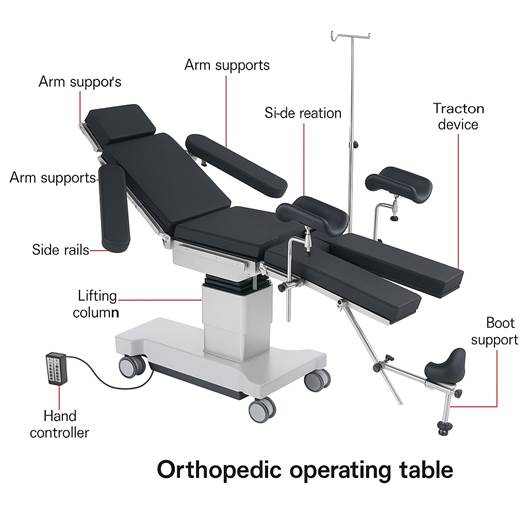
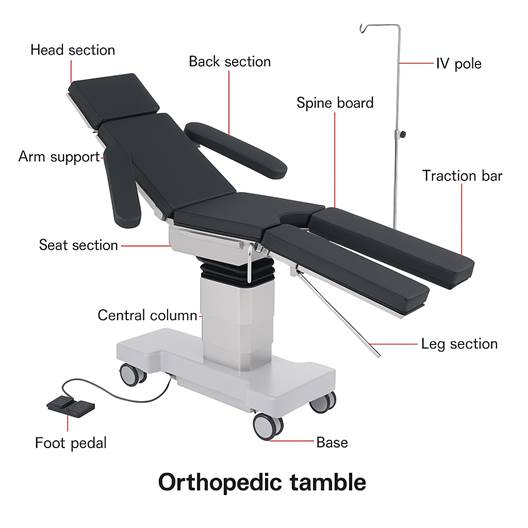
Orthopedic OT Table
History: Orthopedic Operation Theater tables were developed to facilitate bone surgeries, traction, and joint procedures. The introduction of traction frames and spine boards marked a turning point in orthopedic surgery during the 20th century.
Short Specifications:
– Specialized traction frames and posts
– Spine and shoulder supports
– X-ray/C-arm compatibility
– Central lifting column with motorized height adjustment
– High stability for long surgeries
Annotation: Annotated diagram highlights traction devices, spine boards, shoulder supports, arm supports, foot pedals, and lifting column.
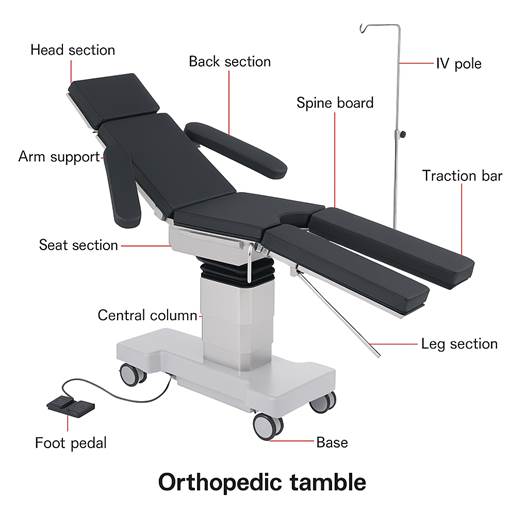
Orthopedic Operation Theater Table
Neurosurgery Operation Theater Table
History: Neurosurgical Operation Theater tables evolved alongside advances in brain and spinal surgery. The incorporation of skull clamps and precise positioning mechanisms allowed surgeons to perform delicate procedures safely.
Short Specifications:
– Head section with skull clamp
– Carbon fiber tabletop for imaging
– Fine tilt and rotation controls
– Compatible with neuronavigation systems
– High precision locking system
Annotation: Annotated diagram features headrest with skull clamp, arm boards, seat and back sections, lifting column, side rails, and brake pedals.
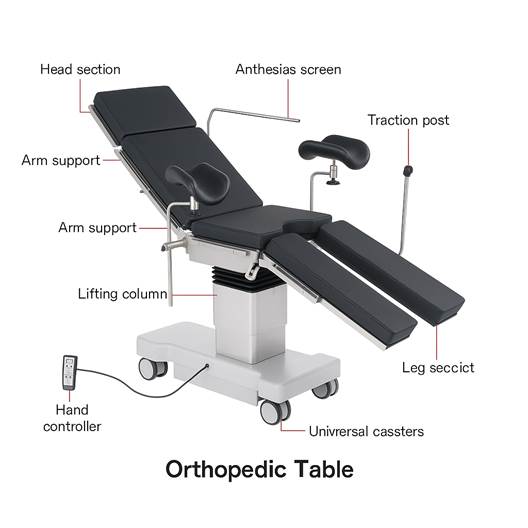
Neurosurgery OT Table
Gynecology/Obstetric Operation Theater Table
History: These Operation Theater tables were designed to support childbirth, gynecological, and obstetric surgeries. From the early 20th century, adjustable lithotomy positions and perineal cut-outs became standardized.
Short Specifications:
– Lithotomy position cradles and stirrups
– Perineal cut-out section
– Adjustable backrest and seat plate
– Manual/electric adjustment
– Compact base for ease of access
Annotation: Annotated diagram highlights headrest, leg crutches, arm supports, perineal section, lifting column, and base.
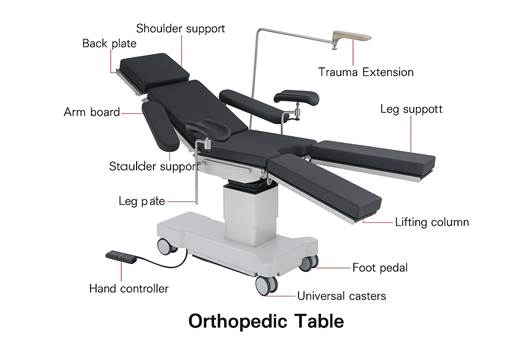
Gynecology/Obstetric Operation Theater Table
Urology Operation Theater Table
History: Urology Operation Theater tables emerged with the rise of specialized surgeries for the urinary tract. The inclusion of irrigation frames and stirrups was key to these tables’ evolution.
Short Specifications:
– Irrigation drain pans
– Perineal cut-out
– Lithotomy stirrups
– Motorized height and tilt control
– Side rails for accessory mounting
Annotation: Annotated diagram includes head section, stirrups, leg plates, traction frame, arm supports, lifting column, and base with foot pedals.
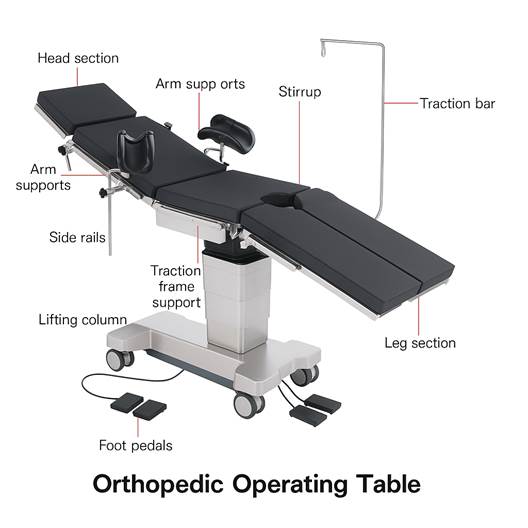
Urology Operation Theater Table
Cardiovascular OT Table
History: With the growth of cardiac surgeries in the mid-20th century, cardiovascular Operation Theater tables were introduced. They feature C-arm compatible surfaces and mobility for imaging during surgery.
Short Specifications:
– Radiolucent tabletop
– Sliding C-arm compatible surface
– multi-section adjustability
– Motorized tilt/height adjustment
– Strong weight-bearing base
Annotation: Annotated diagram features headrest, arm boards, sliding tabletop, foot pedals, lifting column, and mobile base.
Cardiovascular OT Table
Electro-hydraulic Operation Theater Table
History: Electro-hydraulic Operation Theater tables became widely adopted in the late 20th century, combining electrical precision with hydraulic stability. They are now the gold standard in multi-specialty surgical suites.
Short Specifications:
– Motorized adjustment of all sections
– Kidney bridge support
– Remote hand controller
– Electro-hydraulic lifting column
– Universal casters with brakes
Annotation: Annotated diagram includes head section, back section, kidney bridge, leg section, arm supports, anesthesia screen, and hydraulic base.
Electro-hydraulic Operation Theater Table
Comparative Specifications Overview
| OT Table Type | Key Features | Special Uses | Imaging Compatibility | Control System |
|---|---|---|---|---|
| General Surgery | Multi-position adjustable | General procedures | Yes | Manual/Electric |
| Orthopedic | Traction frames, spine board | Bone, joint, trauma | Yes | Motorized |
| Neurosurgery | Skull clamp, fine tilt | Brain & spinal surgery | Yes | Motorized |
| Gynecology/Obstetric | Lithotomy supports, perineal cut-out | Childbirth & OB/GYN | Limited | Manual/Electric |
| Urology | Drain pans, stirrups | Urinary tract surgeries | Yes | Motorized |
| Cardiovascular | Radiolucent, sliding top | Heart & vascular surgery | Yes | Motorized |
| Electro-hydraulic | Kidney bridge, remote control | Multi-specialty surgeries | Yes | Electro-hydraulic |
Applications & End Users
Each OT table type is suited for specific medical disciplines:
– General Surgery: Multi-specialty hospitals
– Orthopedic: Trauma centers, orthopedic hospitals
– Neurosurgery: Neuro-specialized units
– Gynecology/Obstetrics: Maternity hospitals
– Urology: Urology centers, dialysis clinics
– Cardiovascular: Cardiac institutes
– Electro-hydraulic: Multi-specialty surgical suites
Compliance & Standards
Modern Operation Theater tables are designed to meet global safety and performance standards, including:
– CE Marking (European compliance)
– ISO certifications (quality management)
– FDA approval (where applicable)
– Compatibility with C-arm imaging and patient safety guidelines
Maintenance & After-Sales Service
Ensuring reliable operation requires:
– Regular inspection of mechanical and electrical systems
– Preventive maintenance schedules
– Availability of spare parts
– Warranty and technical support
Most suppliers provide a 1–2-year warranty with optional extended service contracts.
Pricing Tiers
| OT Table Type | Standard Price Range (USD) | Premium Price Range (USD) | Remarks |
|---|---|---|---|
| General Surgery | $2,500 – $5,000 | $6,000 – $8,000 | Widely used; standard versions economical |
| Orthopedic | $4,000 – $7,000 | $8,000 – $12,000 | Higher cost due to traction frames |
| Neurosurgery | $6,000 – $10,000 | $12,000 – $18,000 | Precision head clamps & navigation compatibility |
| Gynecology/Obstetric | $3,000 – $5,500 | $6,000 – $9,000 | Lithotomy supports & compact design |
| Urology | $3,500 – $6,500 | $7,000 – $10,000 | Includes irrigation accessories |
| Cardiovascular | $5,000 – $9,000 | $10,000 – $15,000 | Sliding top & radiolucent surfaces increase cost |
| Electro-hydraulic | $7,000 – $12,000 | $13,000 – $20,000 | Flagship models with advanced motorized features |
Customization Options
To meet diverse hospital requirements, Operation Theater tables can be customized with the following options:
– Material Options: Stainless steel base, antimicrobial coating, carbon fiber tabletops.
– Control Systems: Manual, electric, or fully electro-hydraulic with remote control.
– Imaging Compatibility: C-arm compatible surfaces for advanced imaging support.
– Attachments: Specialized headrests, arm boards, lithotomy cradles, drainage pans, and kidney bridges.
– Weight Capacity: Enhanced load-bearing for bariatric surgery models.
– Mobility: Fixed or mobile bases with locking casters.
– Color & Upholstery: Choice of cushioning materials, colors, and antimicrobial fabric.
– Power Options: Battery back-up for uninterrupted performance during surgeries.
Conclusion
Choosing the right Operation Theater table ensures surgical precision, patient comfort, and long-term reliability. With diverse options ranging from general surgery to highly specialized procedures, hospitals and clinics can select models that meet their unique requirements. By offering multiple pricing tiers and customization options, suppliers can provide the right balance of affordability, functionality, and advanced features. Contact us for tailored solutions and pricing. You can Buy it from Pulse ProCare and Promixco Ltd
Prepared by
Entrepreneur | Policy Advocate | Business Leader | Women Empowerment Advocate | Social Visionary