Hospital Furniture
 Medical Devices
 MSR Products
 Office Furniture
Weight scales are essential medical devices for accurate measurement of body weight and patient monitoring across healthcare settings. This catalog presents the 10 major categories of weight scales, with history, specifications, annotated diagrams, applications, compliance, maintenance, pricing tiers, and customization options.
Mechanical Weighing Scale (Analog)
History: Traditional spring-based scales have been widely used since the 20th century.
Short Specifications:
- Analog dial display
- Capacity: up to 150–200 kg
- Steel platform with anti-slip surface
- No battery required
Digital Personal Scale
History: Introduced in the late 20th century, offering precise digital readouts for personal/home use.
Short Specifications: - LCD
- Capacity: 150–200 kg
- Battery-operated
- Auto-calibration, auto-off
Infant/Neonatal Scale
History: Specialized for newborns and infants, with cradles for safety.
Short Specifications: - High precision (±5g)
- Capacity: up to 20 kg
- Removable baby tray
- Digital display with hold function
Pediatric Scale
History: Scaled-up version of neonatal scales, designed for children up to 50 kg.
Short Specifications:
- Capacity: up to 50 kg
- Child-friendly design
- Digital or mechanical options
- Safety rails are optional
Chair Scale
History: Developed for patients unable to stand; integrates weighing into a chair.
Short Specifications:
- Capacity: 200–250 kg
- Digital display
- Foldable armrests and footrests
- Wheels with brakes
Wheelchair Scale
History: Platform scales with ramps for weighing wheelchair-bound patients.
Short Specifications:
- Capacity: 300–500 kg
- Large platform with ramps
- Tare function for wheelchair weight
- Digital readout
Bed Scale (Integrated)
History: Evolved for ICU and immobile patients, built into hospital beds.
Short Specifications:
- Capacity: up to 400 kg
- Accuracy ±100g
- Digital bedside display
- Integration with ICU beds
Bariatric Scale
History: Designed for obese patients requiring higher weight capacity.
Short Specifications:
- Capacity: 300–500 kg
- Reinforced platform or chair design
- Wider dimensions
- High durability
Column/Medical Floor Scale
History: Standard in hospitals and clinics with a height rod attachment.
Short Specifications:
- Capacity: up to 250 kg
- Height rod (stadiometer) integrated
- Digital or mechanical options
- Non-slip base
Precision Laboratory Scale (Analytical Balance)
History: Laboratory-grade for exact mass measurement of samples and medicines.
Short Specifications:
- Accuracy: 0.001g to 0.1g
- Capacity: 200–500g
- Glass shield chamber
- Digital calibration system
Applications & End Users
Weight scales are used in homes, clinics, hospitals, ICUs, pediatric wards, bariatric centers, and laboratories. Applications include: - Routine weight monitoring
- Growth tracking in infants and children
- Clinical diagnosis and dosing
- ICU monitoring for immobile patients
- Bariatric care
- Laboratory precision measurements
Compliance & Standards - ISO 13485 certification for medical devices
- CE Marking for European market compliance
- FDA clearance for the US market
- DGDA/BSTI certification for Bangladesh
- Calibration standards traceable to national metrology bodies
Maintenance & After-Sales Service - Regular calibration and accuracy checks
- Battery replacement (digital models)
- Platform cleaning and anti-slip surface maintenance
- Spare part availability (displays, sensors, trays)
- Service contracts for hospital-grade and ICU-integrated scales
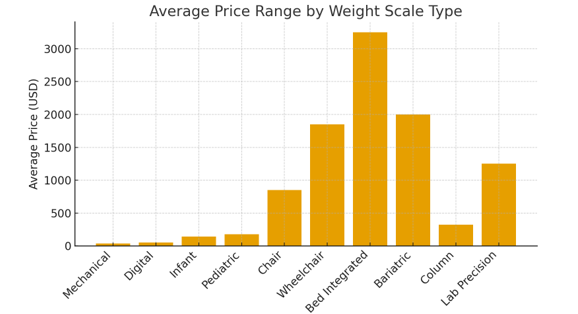
Pricing Tiers
Customization Options - Platform size adjustments
- Digital or analog displays
- Child-friendly designs for pediatric scales
- Higher capacity customization for bariatric units
- Integration with EHR/EMR systems for hospitals
- Connectivity: Bluetooth, Wi-Fi for telehealth solutions
- Battery backup or solar-powered models
Conclusion
Weight scales are vital in healthcare, ensuring accurate monitoring across patient categories and clinical settings. With diverse options available, facilities can choose scales tailored to their needs, budget, and compliance requirements. - Prepared by
Mousumi Islam
Entrepreneur | Business Leader | Policy Advocate | Global Connector | Champion of Women’s Empowerment | Social Visionary | Maritime & Blue Economy Leader | Healthcare & Medical Devices Industry Leader
Annex: Infographics
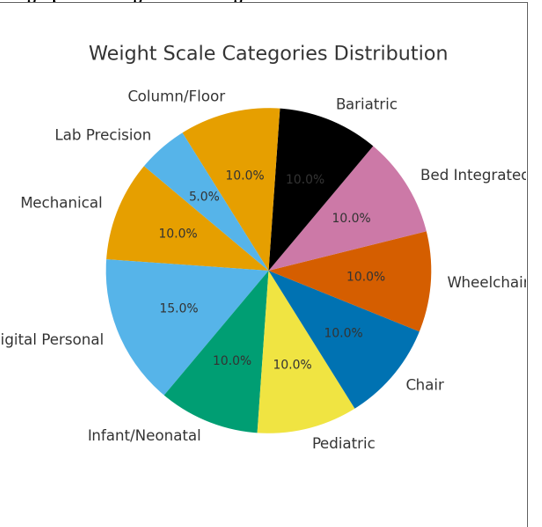
Infographic 1: Weight Scale Categories
Infographic 2: Average Price Ranges