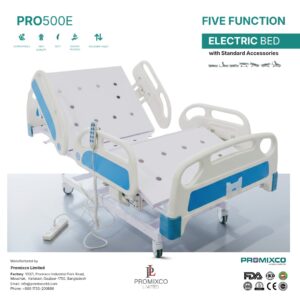
Trust in hospital furniture isn’t built by a marketing claim — it’s built on a factory floor, in the sequence of decisions made from the first cut of raw material to the final inspection before a bed leaves the warehouse. For Promixco Limited, Bangladesh’s first DGDA-approved hospital furniture manufacturer, that sequence is exactly where its reputation comes from. As the company puts it plainly: quality is not inspected in at the end — it is built in from the first cut.
This is a look inside what a DGDA-certified manufacturing line actually involves, and why that process — not just the certificate it produces — is what genuinely separates trustworthy hospital furniture from furniture that simply looks the part.
Where It Starts: A Purpose-Built Manufacturing Base
Promixco Limited’s production isn’t a workshop bolted onto a distribution business — it’s a dedicated manufacturing operation built on ten acres at the Promixco Industrial Park in Gazipur, designed specifically for hospital furniture and medical device production at scale. Having a purpose-built facility of this size matters because it enables the kind of vertical integration that smaller, fragmented manufacturing setups simply can’t achieve: raw material processing, fabrication, assembly, and finishing can all happen under one roof, under one consistent quality system, rather than being scattered across subcontractors with varying standards.
That vertical integration is a deliberate choice, and it directly supports consistency, traceability, and scalability — three qualities that matter enormously when a hospital is ordering dozens or hundreds of identical beds and needs every single unit to perform exactly the same way.
Quality Built In From the First Cut
The manufacturing philosophy behind Promixco Limited’s furniture line rests on a specific idea: quality control isn’t a final checkpoint before shipping — it’s embedded at every stage of production, starting with how raw materials are selected and processed.
Raw material sourcing. Every component begins with material selection that prioritizes long-term durability over short-term cost savings — a foundational decision, since a hospital bed’s frame quality determines how it holds up under years of repeated adjustment cycles and continuous load-bearing use.
Fabrication and welding. Frame construction follows strict process controls rather than ad hoc assembly, ensuring welded joints and structural components meet consistent strength and durability standards across every unit produced, not just the units that happen to get closer scrutiny.
Component testing. Individual components — bed frames, side rails, wheels, motors on electric models — are tested under quality control standards before being assembled into a finished product, catching defects at the component level rather than discovering them after final assembly.
Final product testing. Completed furniture undergoes final testing before leaving the factory, verifying that the finished product performs as specified rather than relying solely on the assumption that correctly tested components automatically produce a correctly functioning final product.
This layered approach — quality checks at material, component, and final-product stages — is what “built in, not inspected in” actually means in practice.
Operating Under ISO 13485:2016
Promixco’s factory operations align with ISO 13485:2016, the internationally recognized quality management standard specifically for medical device manufacturing. This isn’t a generic quality badge — ISO 13485 requires documented, auditable processes covering design controls, risk management, supplier qualification, and corrective action procedures, all specific to the unique demands of manufacturing products that directly affect patient safety.
Operating under this standard alongside domestic DGDA approval means Promixco Limited’s manufacturing line has to satisfy two overlapping sets of scrutiny simultaneously — Bangladesh’s national regulatory requirements and an internationally recognized quality management framework — rather than treating either as a standalone checkbox.
What DGDA Approval Adds on Top of Internal Quality Control
Internal quality control is necessary, but it isn’t sufficient on its own to establish external trust — which is precisely the gap DGDA approval is designed to close. As Bangladesh’s first DGDA-approved hospital furniture manufacturer, Promixco Limited’s processes have been reviewed and verified by an external regulatory body under the Ministry of Health and Family Welfare, rather than relying solely on the company’s own internal assurances.
That distinction matters enormously to hospital buyers. A manufacturer can describe its own quality control process in as much detail as it likes, but DGDA approval means an independent authority has actually looked at that process — and the resulting furniture — and confirmed it meets the country’s regulatory bar for medical devices.
Engineering Refinement Driven by Clinical Feedback
A manufacturing line that produces the same design indefinitely, regardless of real-world performance, eventually falls behind clinical needs. Promixco’s engineering and design teams work directly with healthcare professionals — clinicians and biomedical engineers who use the equipment daily — to continuously refine models based on real clinical feedback and evolving requirements, rather than treating a product design as finished the moment it first enters production.
This feedback loop is part of what allows a hospital furniture manufacturer to offer meaningful customization: adapting dimensions, materials, and features to a specific facility’s actual layout and workflow, instead of forcing every buyer into an identical, one-size-fits-all product.
Certification as a Foundation for Export, Not Just Domestic Trust
Because Promixco Limited’s manufacturing line satisfies DGDA requirements alongside ISO 13485, CE marking, and US-FDA alignment, the same production standards that build trust domestically also open the door internationally. A manufacturing line built to satisfy only the minimum domestic bar would struggle to compete for export orders or international tenders that expect globally recognized certification. Building the line to a higher, internationally aligned standard from the outset avoids that ceiling entirely.
Why This Process — Not Just the Certificate — Is What Builds Trust
It’s tempting to think of DGDA certification as a single stamp of approval, but the real trust a hospital places in a manufacturer comes from understanding the process behind that stamp: purpose-built facilities, vertically integrated production, layered quality checks from raw material to final testing, an internationally recognized quality management system, continuous engineering refinement based on clinical feedback, and independent regulatory verification tying it all together.
That combination is difficult for a smaller or less disciplined manufacturer to replicate quickly, which is precisely why it functions as a genuine differentiator rather than a marketing talking point.
Final Thoughts
A DGDA-certified manufacturing line isn’t a single checkpoint — it’s an entire operating philosophy, applied consistently from the first raw material delivered to the factory floor through to the final tested unit leaving the warehouse. For Promixco Limited, that philosophy has translated into supplying the majority of Bangladesh’s domestic hospital furniture market while meeting the certification standards needed to compete internationally — proof that trust, in this industry, is manufactured just as deliberately as the furniture itself.